Category Archives: Author Advice

Rule #1 of 32 Simple Rules to the Writing the Best Novel Ever

One of the on-line writing groups I belong to has devoted several chat sessions to the article Hunting Down the Pleonasm, by Allen Guthrie. Unfortunately, my schedule has not allowed me to participate in any of the discussion thus far, but I did take the opportunity to read the article—and I’m so glad I did.

For the next several weeks, I’m going to dissect this article/essay and really think over each section.  Since I remember things better when I write them down, I figured I might as well post them up here as a series and discussion topic.  This way we can all chat, and maybe learn from each other as well.

I can’t stress strongly enough that writing is subjective. We all strive for different goals. Consequently, we all need our own set of rules—and some of us don’t need rules at all! Personally, I like rules. If nothing else, it’s fun breaking them.  [Hunting Down the Pleonasm, by Allen Guthrie]

So let’s chat about number one, which defines that wacky word I’ve never heard of before…

1: Avoid pleonasms. A pleonasm is a word or phrase that can be removed from a sentence without changing its meaning. For example, in “Hunting Down The Pleonasm”, ‘down’ is pleonastic. Cut it and the meaning of the sentence does not alter. Many words are used pleonastically: ‘just’, ‘that’ and ‘actually’ are three frequently-seen culprits (I actually just know that he’s the killer can be trimmed to I know he’s the killer), and phrases like ‘more or less’ and ‘in any shape or form’ are redundant [Hunting Down the Pleonasm, by Allen Guthrie]

Now, I KNOW I don’t use “more or less” or “in any shape or form” because they would both set off my cliché alarm.  I have caught myself using “just” once in a while… but I’m not sure about the other two.  I’m going to go run a search on my nearly completed manuscript FIRE IN THE WOODS for these words.  You go take a look at yours, and let’s meet back here.

swish skid mark

Okay… Here’s the scoop.

There are 203 cases of “just” in my novel.  Probably too many for 270 pages, don’t you think?  It seems that most of them are in dialog, but let’s take a look at a few that aren’t:

Staying in the house was just too much to ask. This was the story of a lifetime. I just couldn’t let it slip by without getting something on film.

Okay, taken out of context the two “justs” next to each other scream at me. The second one will definitely go.  Now the first one… does the sentence sound fine without it?  Yes, of course it does, but I think the “just” in this case, is part of the teenage voice in the novel.  For now, I think the first one will stay—but knowing me it will start annoying me now, and get deleted eventually.

Here’s a “that” instance…

You promised that you wouldn’t let anything happen to me

Each switch up to “You promised you wouldn’t let anything happen to me”

swish skid mark

Here are my total counts:

Original appearances of “Just” = 203 (85% in dialog)

# After search/edit = 114 (mostly dialog)
swish skid mark

Original appearances of “Actually” = 22 (only 5 outside dialog)

# After search/edit = 21 (only 4 outside dialog)

swish skid mark

Original appearances of “That” = 448 (Yikes!)

# after search/edit = 395 – most in dialog, but only 63 could be removed without messing up the sentence. I will look at this again in the final read-through.

How’d you do?  What other words have you come across that can be deleted without changing the meaning of your sentence?
JenniFer_EatonF

#carinapitch Carina Press Twitter Pitch event is on NOW. Have a novel to pitch?

The Carina Press editorial team will be holding a pitch event on Twitter via the #carinapitch hashtag on Thursday, April 4, 2013 from 8am Eastern to 9pm Eastern.

Reblog from Carina Press– Angela James | March 30th, 2013

Last fall, we provided an opportunity for authors to submit their work and get both an expedited response and feedback. We had tremendous response to that submissions call, so we decided to do something that would give authors the chance to get similar feedback and response time. I’d also like to share that, from that submissions call, we found over a dozen manuscripts that we either wanted to acquire or see further revisions for, so it was very successful for both authors and us in that regard. Our ultimate goal is always to find new authors to acquire, not new authors to reject!

Last time, we heard from authors who had submissions pending that they wished they could also have the opportunity to take advantage of that, so we’ve come up with a pitch event that will allow everyone, including those who currently have submissions pending, the same chances. Please read on for details of how the event will work.

On Thursday, Carina Press freelance editors will be monitoring the #carinapitch hashtag for book pitches from authors.

The benefits:

Book pitches chosen by editors will be reviewed by the editor who requested it. Response will be given by May 31st, 2013 and those manuscripts chosen via the #carinapitch will also receive personalized feedback. Please note that we ask authors not to expect paragraphs of feedback, but specific feedback will be offered noting what the editor sees as not working or needing attention. We also would like to emphasize that the nature of this business is subjective, so the editor may provide feedback the author may not agree with. We’re offering insight into why the book doesn’t work for us (should we choose to pass on it, rather than acquiring, which is certainly a possibility!), not providing detailed instructions on how to “fix” any issues we see.

Eligibility to participate:

1) A complete, ready-to-send, manuscript that falls within the commercial fiction genres that we publish. (Please view our submissions guidelines here)

2) You must be prepared to send your manuscript within 3 days of the #carinapitch session. Any manuscripts sent after Sunday, April 7th will still be fairly reviewed by editorial staff, but won’t be eligible for the feedback/accelerated response time.

3) The manuscript you’re pitching must be new material, not previously published material, whether self-published or released via a publisher. New material only will be considered during this event.

4) The manuscript cannot be one that has previously received a pass letter from us.

5) You may pitch more than one project.

How to participate:

1) Wait until April 4th from 8am Eastern to 9pm Eastern, which is when the editors will be monitoring the hashtag.

2) Craft your compelling book pitch into one (no more than two) tweets. Indicate if it’s more than one tweet by using 1/2 and 2/2 so we can piece them together.

3) Post them to Twitter from your account using the #carinapitch hashtag (the only way we’ll know they’re for us!)

  • Please do not post pitches for one book more than twice during the #carinapitch event. Even if you’re changing your pitch, please pitch the same book no more than twice during the day.

4) Watch for a reply from a Carina Press editor.

5) If an editor lets you know that they’d like to see your submission and your manuscript is NOT currently on submission with us:

  • a) please follow the submission guidelines here and include all required information. Send your submission to the submissions email, not the editor directly.
  • b) Make your subject line: #carinapitch Title by Author (genre)
  • c) Address your query letter to the editor who requested your manuscript
  • d) At the top of your query letter, please include the Twitter pitch you used and your Twitter name (to help the editor recognize your request & verify that they asked for it)
  • If more than one editor asks for your submission, you may choose which editor to send to, though you may also wish to indicate the second editor who had interest, in case the first editor chooses not to read it.
  • e) Send your submission no later than Sunday April 7, 2013

6) If an editor lets you know they’d like to see your submission and your manuscript is already in our queue.

  • a) Send an email to submissions@carinapress.com
  • b) Subject line: #carinapitch Existing Submission
  • c) In the body of the email, please include the Twitter pitch you used and your Twitter name (to help the editor recognize your request & verify that they asked for it).
  • d) In body of email, please tell us the date you originally submitted your work, the title of the work, the genre and the name you submitted under. It’s helpful if your email comes from the same email address you used to submit the work.
  • If more than one editor asks for your submission, you may choose which editor to send to, though you may also wish to indicate the second editor who had interest, in case the first editor chooses not to read it.
  • e) Email us no later than Sunday April 7, 2013

Notes about #carinapitch

  • You don’t need to direct your tweet to a specific editor. We’ll all be monitoring the hashtag throughout the day. However, if you want to bring it to the attention of an editor you think it’s particularly suited for, you are welcome to do so. At the bottom of this post is a list of participating Carina Press editors and their Twitter IDs.
  • Please don’t post your pitch more than twice during the day. We know you want to make sure we see it, so we don’t mind if you post it at two different times, but please don’t post one book more than that. This includes not changing your pitch five times and posting it five different ways, please. Two pitches per book, so the hashtag doesn’t become cluttered and allows all authors equal opportunity to be seen. Thank you!
  • An updated list of what different editors are looking for will be posted here on the blog Monday. You can see editor bios here.
  • Information about what we publish, our submissions guidelines and specific FAQs can be found here.

Feedback is welcome! Please email us at generalinquiries@carinapress.com if ever you have specific, constructive feedback you’d like to share.

One last (very important) note:

Even if your pitch isn’t selected by an editor, that doesn’t mean your project isn’t right for us. In the end, it’s the words you write in the story that will get us to acquire the book, not the words you wrote for the pitch, so if you’ve written something we publish, please still submit it to us. Your chances of having the manuscript acquired are just as good as those whose pitches we single out!

*Permission to forward this post, use it on blogs and author forums is permitted.*

Participating editors:

Angela James @angelajames

Tina Burns @TinaBurns

Deb Nemeth @DebNemeth

Jeff Seymour @realjeffseymour

Elizabeth Bass @ElizabethBass

Melissa Johnson @MelissJohnson

Gina Bernal @GinaBernal

Alissa Davis @AlissaDenay

Mallory Braus @MalloryBraus

Meredith Giordan @MeredithGiordan

Megan Records @MeganRecords

What the… Oh My Gosh, Oh No, Oh Crap, and whatever…

Final edits can be maddening, can’t they? As I go through my list of overused words, I always find new things that make me giggle.

My current giggle-a-thon is coming in the form of teenage explicatives.  They sound perfectly right in-context. “Oh my gosh, you are not going to do that!”

Buy when I ran a search on “Oh” and my screen lit up with pretty highlights—I realized how many of my main character’s dialog lines start with the word “Oh”.  It’s funny really.

The good thing about using the search feature to ferret out these little problem is you can look at each instance outside of the frame of the narrative.  It’s much easier to edit when you are not getting “caught up” in the story.

So, at the moment I am in final edits for Fire in the Woods, and I am removing a good portion of the “Oh my gosh”, “Oh my God”, “Oh crap,” and of course, the every-so intrusive “umm”.

Of course, I am leaving in a few for color, but I’m trying to cut my repetition down to once every ten pages or more. (Quite a feat at times.)

How do you search and destroy over-used words and phrases?

JenniFer_EatonF

Please don’t send me to the slush pile! I’ve been good!

A temporary goodbye to the Little Blue Lady from Mars

PKO_Alien 3 0003387You are going to shove me into your hard drive and never look at me again.

No, I’m not!

I promise!

Alien Smile CloseBut I’m a rehabilitated alien! 

I made cookies last week and everything!

It’s not that.  Your interviews have been great. Hundreds of people have clicked on over to read them. I’ve gotten a great response—even when you’ve been abrasive, which is a bit odd.

PKO_Alien 3 0003387Then what’s the problem?

.

Time is the problem.

Did you know it takes a few hours to do one of those interviews?

PKO_Alien 3 0003387Ha!  You’re not doing anything.  I’m doing all the work. 

You’re just whining and complaining in the background.

Yes, but as much as I love you,

there is a little work involved in bringing you to life.

PKO_Alien 3 0003387So?

.

Well, I’ve got writing to do, you know.  I’m starting the sequel to Last Winter Red this weekend, and I have three books out to query now, and Fire in the Woods will be going to query in a few weeks.

Alien Huh CloseThey are more important than me?

Hmm. At the moment, yes, they are.  But listen, I promise to set up an interview for you at least once a month.  Twice once I get a little more acclimated to my new schedule, okay?

PKO_Alien 3 0003387[Sigh]

I guess I really don’t have a choice, do I?

Sorry.

.

PKO_Alien 3 0003387I’ll miss you.

.

I’ll miss you too.

But I’ll see you in a few weeks, I promise.

Free_Fridays!

Alien SmileOkay. 

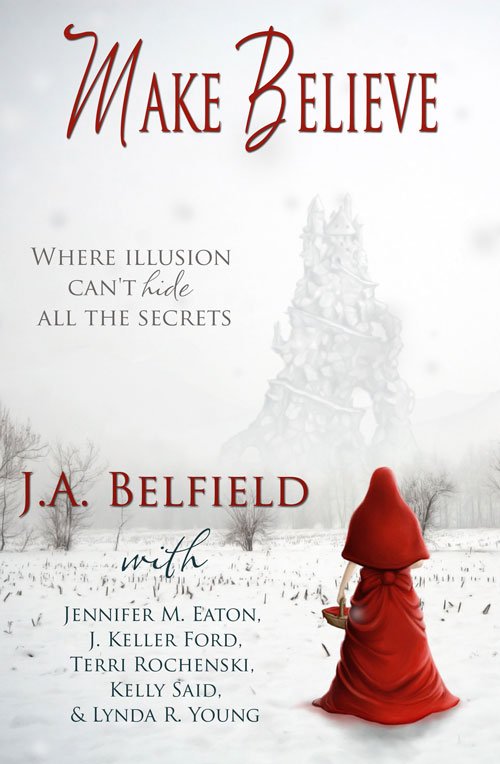
How about for the last Free Friday for a while, we give away a copy of “Make Believe”.

Great!  That would be awesome.

You know, the reviews for my story Last Winter Red in this anthology have been “off the charts crazy” good!  And several people have asked about more from the Last Winter Red world.

PKO_Alien 3 0003387Well, I’m happy for you, but not happy that writing the sequel means I have to go back into the hard drive.

Hey, I will keep my promise.

I even have an awesome author all lined up for April.

PKO_Alien 3 0003387All Right. 

.

Make Believe

Please bid the Little Blue Lady goodbye for a few weeks, and everyone commenting below will be in the running for an ebook copy (your choice of format) of the “Make Believe” anthology including my story LAST WINTER RED.

.

.

The Little Blue Lady From Mars © Jennifer M. Eaton.

JenniFer_Eaton Sparkle__F

Writing Madly to a Deadline, and then NOT submitting

I recently jumped into the running for another anthology, which means writing to a tight deadline.  I tripped up my schedule for a few weeks, finalizing my novel for the Amazon Break Through Novel Contest, and was two-weeks behind schedule. I DID finish in time (barely), but now I sit here the day before the deadline, with a completed manuscript in my hands, second guessing myself.

Do I think it’s not good enough?  No.  The opposite.  It’s tight. It’s precise….

And if you could have seen the look on my son’s face after reading it— Dang.  I haven’t seen him this excited about something since finishing the Hunger Games (Not that mine is even remotely like the Hunger Games)

So what’s the problem?  Submit the dern thing!

Here’s my problem… It’s too long.  I did not make the word count.  I contacted the publisher, and they said they would consider it at the higher word count, but it definitely would have to be cut down by 1500 words for publication in the anthology (If it were chosen)

I searched for those 1500 words, and found a possible 500 to cut, but editing out those 500 would have affected the “mood” of the story.  And if another 1000 words were cut after that, the whole story would seem rushed.

If my son had said “Meh, it’s okay.  I’ve read better.” (Which he has done to me in the past) I would have sliced and diced the 1500 words out of the story and sent it in.

But he didn’t say that.  He asked for more.  My kid the voracious reader said:  “It was really great.  I’ve never read anything like that before.  When will you write another one?”

I thought about what those forced changes would do, and decided to take the creative high road.  I am passing on the anthology, and am now embarking on a search for a publisher of Young Adult Paranormal Short/Novellas.

Ugh!  I hate passing up an opportunity, but I think this particular story needs to find a more suitable home than the confines of an anthology.

I am all for editing… all stories need to be edited, but I don’t want to “cut” just for the sake of “cutting”.  I’d rather have words cut because they don’t belong there… not because there is a stipulation on word count.

Have you ever found yourself in a situation like this?

If not, do you think you’d submit anyway, or search for a new home?

_JenniFer____EatoN

Are you in the Central Jersey Area? Author’ Panel Saturday

‘I’VE FINISHED MY FIRST DRAFT, NOW WHAT?’
Local authors share tips and information on getting published in today’s market (organized by the New Jersey Authors Network: http://www.njauthorsnetwork.com).

So you’ve finished the writing your book/story, or have you?

What (if any) revision work needs doing?


Where can you go for feedback?

How will you know when it’s ready to send out, and where should you try first?

Join New Jersey Authors, Jon Gibbs (moderator); Kristin Battestella; Karen Bostrom; Jennifer Eaton; Jim ‘JJ’ Lair, and Nicole Zoltack, for a fun, informative discussion on getting published in today’s market, and find out why typing ‘THE END’ is really just the beginning.

See you there for a great discussion!

JenniFer_Eaton Sparkle__F

Give that Publisher What They Want, Dernit! Finale

I am uber stoker to be able to dig into the wild and crazy brain of someone who is out there doing this crazy publishing stuff professionally. When you read this, you’re gonna want to slap yourself silly, because this is hearing it right from someone who does this for a living. For the next few weeks, we will be delving into the slush pile with professional editor and author Danielle Ackley-McPhail

Here we go…

The Writer’s Toolbox: Give ’Em What They Want! Why Formatting Is Important By Danielle Ackley-McPhail

(Originally published in Allegory Magazine ©2011)

—————————————————————–

Here is a listing of all the Posts from Danielle on this topic.  Good Stuff if you missed any of them!

Post one Don’t get all creative now!

Post two Duh – Contact Info

Post three Basics 2 – Identifiers

Post four Formatting #1

Post five Formatting #2 Advanced

Post six Ellipses, Emdash, Quotes

Post seven Keep It Simple

Summing Up

You might think this article was about the technical aspects of formatting, but you would only be partially correct. What this article is truly about is respect. If you want to succeed at this dedicated hobby you’ve chosen to pursue (believe me, you don’t want to think of it as a career…it only leads to masses of frustration) then you need to get your head in the correct mindset. You are not alone in your desire. There are countless individuals who want to be authors. There are a considerably less individuals who are in a position to make that possible. Editors have to look through hundreds, even thousands of manuscripts every year. I don’t think I have to tell you that they can’t accept them all. You know what that means? It is your job to make their job as easy for them as possible. You can do that in two ways:

  • Ignore what I’ve shared with you here and start deciding which room you are going to wallpaper with rejections first, or
  • Do everything you can to make your manuscript clean and formatted to the publisher’s preference so that technical issues don’t distract the editor from the creative aspects of your work.

Now I’m not saying if you follow all the submission guidelines your work is guaranteed to be accepted, but I am saying you stand a heck of a better chance of at least getting noticed.

Special Thanks to Danielle Ackley McPhail for this wonderful insider info!

Thanks Danielle!

Award-winning author Danielle Ackley-McPhail has worked both sides of the publishing industry for over seventeen years. Currently, she is a project editor and promotions manager for Dark Quest Books.

Her published works include four urban fantasy novels, Yesterday’s Dreams, Tomorrow’s Memories, Today’s Promise, and The Halfling’s Court: A Bad-Ass Faerie Tale. She is also the author of a single-author collection of science fiction stories called A Legacy of Stars, the non-fiction writers guide, The Literary Handyman and is the senior editor of the Bad-Ass Faeries anthology series, Dragon’s Lure, and In An Iron Cage. Her work is included in numerous other anthologies and collections, including Rum and Runestones, Dark Furies, Breach the Hull, So It Begins, By Other Means, No Man’s Land, Space Pirates, Space Horrors, Barbarians at the Jumpgate, and Mermaid 13.

She is a member of the New Jersey Authors Network and Broad Universe, a writer’s organization focusing on promoting the works of women authors in the speculative genres.

Danielle lives somewhere in New Jersey with husband and fellow writer, Mike McPhail, mother-in-law Teresa, and three extremely spoiled cats. She can be found on LiveJournal (damcphail, badassfaeries, darkquestbooks, lit_handyman), Facebook (Danielle Ackley-McPhail), and Twitter (DAckley-McPhail). To learn more about her work, visit http://www.sidhenadaire.com, http://www.literaryhandyman.com, or www.badassfaeries.com.

Website and/or blog www.sidhenadaire.com, http://lit_handyman.livejournal.com, http://damcphail.livejournal.com

Twitter https://twitter.com/#!/DMcPhail

Facebook http://www.facebook.com/#!/danielle.ackleymcphail

Amazon author page   http://www.amazon.com/Danielle-Ackley-McPhail/e/B002GZVZPQ/ref=sr_ntt_srch_lnk_1?qid=1331314265&sr=8-1

Goodreads http://www.goodreads.com/author/show/989939.Danielle_Ackley_McPhail

http://www.badassfaeries.com/

http://www.sidhenadaire.com/

Related articles
Related articles
Related articles
Related articles

Give that Publisher What They Want Dernit! – Keep It simple

I am uber stoker to be able to dig into the wild and crazy brain of someone who is out there doing this crazy publishing stuff professionally. When you read this, you’re gonna want to slap yourself silly, because this is hearing it right from someone who does this for a living. For the next few weeks, we will be delving into the slush pile with professional editor and author Danielle Ackley-McPhail

Here we go…

The Writer’s Toolbox: Give ’Em What They Want! Why Formatting Is Important By Danielle Ackley-McPhail

(Originally published in Allegory Magazine ©2011)

—————————————————————–

So far, we’ve discussed that nothing will help your manuscript if the editor in question is not even willing to read it.

We’ve discussed remembering your contact information, and some basics… How to identify yourself, and your manuscript.

Last week we discussed basic formatting.  Now we’ll go into some special stuff.

Keep It Simple

Matters of Style

No matter what I type here there are going to be plenty of examples of publishers that do things different from what I’ve covered. Sometimes that is just a product of their experience or how they were taught. Sometimes it has to do with style guides. You may or may not have heard of these; the most familiar are the AP Style Guide, the Chicago Manual of Style, and Strunk and Whites. Many of these have their roots in print journalism and are meant to unify style for consistency. Basically they are journalists’ grammar and style bibles. Their use is no longer limited to newspapers or magazines. Not only do they guide a writer in matters of style, but they also cover grammar issues that are often confused or lost in depths of time-fogged memory.

Keep it Simple!

Before the time of electronic submissions not listening to this advice was one of the biggest mistakes beginners made. You would laugh your butts off if you had heard some of the stories I have about the manner in which some hopeful authors have submitted their manuscripts. We are talking complete bells and whistles here of the type you would expect from the ad campaign of a major corporation. Everything from fancy, scented paper to puzzle-box packaging, all of it intended to catch the eye and stand out like a psychedelic dream. Unfortunately, all that does is relegate your manuscript to the list of over-drinks stories editors tell.

Things might have changed now that the majority of submissions are handled electronically, but it is still important for you to know that a story should be noticed for the quality of the writing, not the inventiveness or style of its presentation. If you are submitting by conventional mail use plain white or cream bond paper and observe the formatting guidelines I reviewed above; if you are submitting electronically, don’t use fancy type or try to set your manuscript as if it is a finished book; don’t use colored text or insert photographs (unless they are a key point of what you are submitting, such as an academic text or how-to); and don’t add any other bells and whistles you might be considering. Let me be clear: The manuscript should stand on its own merit. If the writing isn’t any good, none of the flash is going to make a difference. What it will do is distract the editor from your work and likely cause them to reject it outright as being unprofessional.

Award-winning author Danielle Ackley-McPhail has worked both sides of the publishing industry for over seventeen years. Currently, she is a project editor and promotions manager for Dark Quest Books.

Her published works include four urban fantasy novels, Yesterday’s Dreams, Tomorrow’s Memories, Today’s Promise, and The Halfling’s Court: A Bad-Ass Faerie Tale. She is also the author of a single-author collection of science fiction stories called A Legacy of Stars, the non-fiction writers guide, The Literary Handyman and is the senior editor of the Bad-Ass Faeries anthology series, Dragon’s Lure, and In An Iron Cage. Her work is included in numerous other anthologies and collections, including Rum and Runestones, Dark Furies, Breach the Hull, So It Begins, By Other Means, No Man’s Land, Space Pirates, Space Horrors, Barbarians at the Jumpgate, and Mermaid 13.

She is a member of the New Jersey Authors Network and Broad Universe, a writer’s organization focusing on promoting the works of women authors in the speculative genres.

Danielle lives somewhere in New Jersey with husband and fellow writer, Mike McPhail, mother-in-law Teresa, and three extremely spoiled cats. She can be found on LiveJournal (damcphail, badassfaeries, darkquestbooks, lit_handyman), Facebook (Danielle Ackley-McPhail), and Twitter (DAckley-McPhail). To learn more about her work, visit http://www.sidhenadaire.com, http://www.literaryhandyman.com, or www.badassfaeries.com.

Website and/or blog www.sidhenadaire.com, http://lit_handyman.livejournal.com, http://damcphail.livejournal.com

Twitter https://twitter.com/#!/DMcPhail

Facebook http://www.facebook.com/#!/danielle.ackleymcphail

Amazon author page   http://www.amazon.com/Danielle-Ackley-McPhail/e/B002GZVZPQ/ref=sr_ntt_srch_lnk_1?qid=1331314265&sr=8-1

Goodreads http://www.goodreads.com/author/show/989939.Danielle_Ackley_McPhail

http://www.badassfaeries.com/

http://www.sidhenadaire.com/

Related articles
Related articles
Related articles
Related articles

Why doesn’t this chapter work? The rules of writing a scene.

Have you ever read something you’ve written, and know that it just doesn’t “work” but you can’t figure out why?

I’m currently reading a beta that is in probably its fiftieth draft. That’s okay.  People write at different speeds.  For me personally, I am reading this manuscript for probably the sixth or seventh time.  Each time I read it, I am pleasantly surprised by the “growth” of the story.

Think GirlSo, here’s where the “Why doesn’t this chapter work” comes in.  I am DEVOURING this manuscript this time around.  The added scenes are spot-on.  The story is exciting and driven.  Then BAM!  I hit a roadblock.

I hit a scene that just didn’t satisfy me.  Was it written well?  Yes.  Did it follow the plot?  Yes.  So what was wrong?

I went back to a writing lesson I learned probably a year ago.  It said that each scene needs to be a miniature story in itself.  It has to start, have a rising action, a climax, a falling action, and a resolution.  Now, I am not saying that this needs to be in depth.  Think of it.  A falling action can be as simple as an emotional response of a character shaking their head… but a scene really DOES need to have all these elements.

The problem with this scene is that it didn’t do this.  It was a scattering of information, mostly that I already knew as a reader, and it did not push the story forward.  No, it was not filler.  I just don’t think the author “did what they intended” to do with that scene.

Now, I’m not psychotic.  I am not saying that I look at every scene I write for rising action, climax and resolution, but I think at this point I naturally write this way… as all serious writers should.

So next time a scene is bothering me, and I can’t figure out why, I’m going to dissect it. Does it have a rising action? Climax? Falling action?

Most importantly … is something resolved?

I think that’s the biggie.  If nothing is resolved (however minor) then the scene does not drive the story forward.

What are your thoughts?

_JenniFer____EatoN

Give that Publisher What They Want Dernit! Part Five – Formatting #3 The dreaded emdash and ellipse

I am uber stoker to be able to dig into the wild and crazy brain of someone who is out there doing this crazy publishing stuff professionally. When you read this, you’re gonna want to slap yourself silly, because this is hearing it right from someone who does this for a living. For the next few weeks, we will be delving into the slush pile with professional editor and author Danielle Ackley-McPhail

Here we go…

The Writer’s Toolbox: Give ’Em What They Want! Why Formatting Is Important By Danielle Ackley-McPhail

(Originally published in Allegory Magazine ©2011)

—————————————————————–

So far, we’ve discussed that nothing will help your manuscript if the editor in question is not even willing to read it.

We’ve discussed remembering your contact information, and some basics… How to identify yourself, and your manuscript.

Last week we discussed basic formatting.  Now we’ll go into some special stuff.

Formatting #3 The dreaded emdash and ellipse (and some stuff on quotations)

Emdash – represented as two hyphens. In this time of computers, most programs automatically convert the double hyphen to an emdash. Depending on the publisher’s preferred style, they will have a space before and after the emdash “—” or “ — ” in the finished book.

Ellipsis – depending on the publisher’s preferred style these can be represented in multiple ways:

  • Three periods in a row with no spaces before, after, or in between. “…”
  • Three periods in a row with a space before and after. “ … ”
  • Three periods with one character space between each period and a space before and after. “ . . . ”

Quotation marks and Apostrophes – many word processing programs have a feature for smart quotes or straight quotes. (For those who don’t know what I mean by smart quotes, those are the curly ones.) I have never encountered a publisher that has expressed a preference either way, but I can tell you that as an editor who is also a typesetter one of my biggest pet peeves is straight quotes. And let me tell you why… Even though it is possible for me to do a simple “Find and Replace” to convert straight quotes into smart quotes, it causes several formatting problems for me. First off, quotation marks sometimes end up facing the wrong direction when they follow punctuation that is not a period, requiring that I go in and manually turn them around. Second, in the case of apostrophes—as opposed to single quotes—when those occur at the beginning of a word, as in the case of dialect ( ’em, ’twere, ’twas, etc), the program does not recognized the convention and flips it around as if it was intended as a single quote, again requiring the typesetter to go through the entire manuscript manually correcting. These aren’t so difficult to correct, but they are definitely easy to miss, thus making them a headache of the highest order when they introduce errors into an already edited manuscript.

Next week we’ll sum all this advice up.

Be there or be square, or, ummm… rejected?

Award-winning author Danielle Ackley-McPhail has worked both sides of the publishing industry for over seventeen years. Currently, she is a project editor and promotions manager for Dark Quest Books.

Her published works include four urban fantasy novels, Yesterday’s Dreams, Tomorrow’s Memories, Today’s Promise, and The Halfling’s Court: A Bad-Ass Faerie Tale. She is also the author of a single-author collection of science fiction stories called A Legacy of Stars, the non-fiction writers guide, The Literary Handyman and is the senior editor of the Bad-Ass Faeries anthology series, Dragon’s Lure, and In An Iron Cage. Her work is included in numerous other anthologies and collections, including Rum and Runestones, Dark Furies, Breach the Hull, So It Begins, By Other Means, No Man’s Land, Space Pirates, Space Horrors, Barbarians at the Jumpgate, and Mermaid 13.

She is a member of the New Jersey Authors Network and Broad Universe, a writer’s organization focusing on promoting the works of women authors in the speculative genres.

Danielle lives somewhere in New Jersey with husband and fellow writer, Mike McPhail, mother-in-law Teresa, and three extremely spoiled cats. She can be found on LiveJournal (damcphail, badassfaeries, darkquestbooks, lit_handyman), Facebook (Danielle Ackley-McPhail), and Twitter (DAckley-McPhail). To learn more about her work, visit http://www.sidhenadaire.com, http://www.literaryhandyman.com, or www.badassfaeries.com.

Website and/or blog www.sidhenadaire.com, http://lit_handyman.livejournal.com, http://damcphail.livejournal.com

Twitter https://twitter.com/#!/DMcPhail

Facebook http://www.facebook.com/#!/danielle.ackleymcphail

Amazon author page   http://www.amazon.com/Danielle-Ackley-McPhail/e/B002GZVZPQ/ref=sr_ntt_srch_lnk_1?qid=1331314265&sr=8-1

Goodreads http://www.goodreads.com/author/show/989939.Danielle_Ackley_McPhail

http://www.badassfaeries.com/

http://www.sidhenadaire.com/

Related articles
Related articles
Related articles
Related articles