Category Archives: Gold Mine Manuscript

Lesson Twelve from the Gold Mine Manuscript Red Line: How Are Your Characters Feeling Today?

For an intro into where these tips are coming from, please see my post: A Full Manuscript Rejection, or a Gold Mine?  You can also click “Rant Worthy Topics” in my right navigation bar.  Choose “Gold Mine Manuscript” to see all the lessons to date.

“Magellan walked back from the library slowly, feeling exhausted from studying all day.”

Sorry, Gellan.  You’re not allowed to “feel exhausted”.  I have totally failed you as a mother author.  (Don’t you feel like their parents sometimes?)  Anyway… .

According to this publisher, Feeling, Felt, and Feel are very telling words.  They are right up there with “look” for setting off the “no-no” meter.  Instead of using these words, we should be showing our readers how our characters feel instead.  Give us actions that show us that he’s tired without telling us that he is.

Errghhh. Okay…

“Magellan dragged his feet as he walked home from the library.  He could barely keep his eyes open after studying all day.”

Okay, they are forgiven.  Point taken.  The second one is better.  The word count does suffer a little in this example, but I could probably have done better if I gave it a little more thought. (They might even consider “barely keep his eyes open” as tell. too.  I could have probably done better there, as well.)

Another bad telly sentence that I would have been guilty of before seeing the Gold Mine Manuscript was something like:

“Magellan was exhausted.  He dragged his feet all the way home”
There is no reason to say “Magellan was exhausted” and SHOW that he is exhausted right afterwards.  Just delete that first part, and stick with the showing part and it will sound much better.

This tip, will definitely help make your manuscript stand out from the others.  I still have to stop myself from doing this.  For some reason, I naturally “tell” First, and then I show.  I don’t know why.  I’m starting to catch myself, but sometimes it’s tough.

Hope this one helps.

If you don’t get it, please drop me a line, and I will discuss in more depth. I think this is a really good point that a lot of people seem to be stumbling with (me included).  I saw it a lot critiquing a recent 250 word contest.  Set yourself apart by trying to avoid it.

Jennifer Eaton

Lesson Eleven from the Gold Mine Manuscript Red Line: Pre-Telling

For an intro into where these tips are coming from, please  see my post: A Full Manuscript Rejection, or a Gold Mine?

I’m not sure I completely agree with this from the angle  where it’s marked, but I’m mentioning it nonetheless.  In the Gold Mine Manuscript, the MC had something weird happen to  him.  It’s something that could possibly  change his life.  One chapter ends  (paraphrasing)  “He had to find the  truth.  He cleaned up the mess, closed  the doors, and formulated a plan.”

The publisher highlighted “formulated a plan” and called it  “Pre-Telling.”  They said this is  telling us what is happening without telling us what “did happen.”  They asked the author to look for instances  like this in the novel and eliminate them.  They wanted her to show them what happened instead.

Now, I read this as a decent chapter close.  It left me wondering what the MC was going  to do.  I think that was the effect that the author was going for.  In my mind,  it gives you a little push to turn the page.  However, my opinion doesn’t really count, does it?  They red-lined it.

Do with this what you like.  I’ve seen this in published work.  Frankly, I didn’t mind it, but somebody “in the know” did.  I suppose, like anything else, once we stop  using little writing crutches like these, and we see what we can do without  them we will realize what better writers we can be.  Which, I suppose is what looking at manuscript red-lines like  this is all about… even if we don’t necessarily agree.

In some cases, you need to decide what is best for you.  However, I would consider trying to write without something like this, and see if you can still get the effect you want without the Pre-Telling.  You probably can.  If you can’t, and you are unhappy,  then maybe you have a decision to make.  Just get ready for the red-line (or maybe not… like I’ve said.  Some publishers have let this go.)

Hope this helps!

Lesson Ten from a Manuscript Red Line: Girls Rule and Boys Drool

For an intro into where these tips are coming from, please see my post: A Full Manuscript Rejection, or a Gold Mine?

Let me start out by stating… if your novel has a female protagonist… I HATE YOU.

Well, not really, but I’m jealous.  You don’t have to worry about a side-kick, because your Girl-Power is already there.  UGH!  This is annoying.

My BP and I actually had this conversation months ago.  We talked about how annoying it is that publishers all seem to want strong female characters only.  Well, at the same time, they are complaining that boys don’t read.  Go figure.

Both my BP and I have male MCs (main characters).  My BP at least already had a female side kick, but they actually asked her to beef her up and make her one of the main voice characters.  She’s working now on making her a more dynamic character.  I guess this is a good thing.  I like her.  She’s a tough cookie, but do we always have to have a girl?

Now, I am a girl, and I happen to like to read books about boys.  Boys tend to be stronger, and I don’t have to worry about annoying sappy emotional crap most of the time.  I’m wondering if more boys actually would read if there was a wider variety of decent novels out there that didn’t force-feed them GIRLS just so the novels would be marketable to a female audience as well.  Maybe publishers are shooting themselves in the foot by not letting girl-free novels into the shelves?  I guess we will never know.

Yeah, I have to admit that Meagan has gotten more and more page-time in my novel, but I’m trying hard not to let her take over.  I’m trying to have her be there, with her own ominous annoying girly agenda, without spoiling the overall plot line.  Meagan is a princess and is trying to find a loophole that will let her marry Magellan, a commoner.  This actually works in nicely, because it makes the villain (her brother) more and more angry and homicidal every time he sees them together.

Hopefully I don’t have to make her too much more integral than she already is.  I want to be published, but I want the story to be intact when I’m done as well.  The story is definitely about a confused boy with no memory that has to save the galaxy… It’s not a love story.

Anyway… the point of this all is that publishers are still looking for a strong female presence in works that they are supporting.  They simply don’t believe there is enough of a male market of readers out there to support a strictly male protagonist.  They said they realized that a writer should not focus on writing to the market only, but it is something that publishers must consider.

Ugh.

Lesson Nine from a Manuscript Red Line: Written Any Good (Bad) Cliché’s lately?

For an intro into where these tips are coming from, please see my post: A Full Manuscript Rejection, or a Gold Mine?

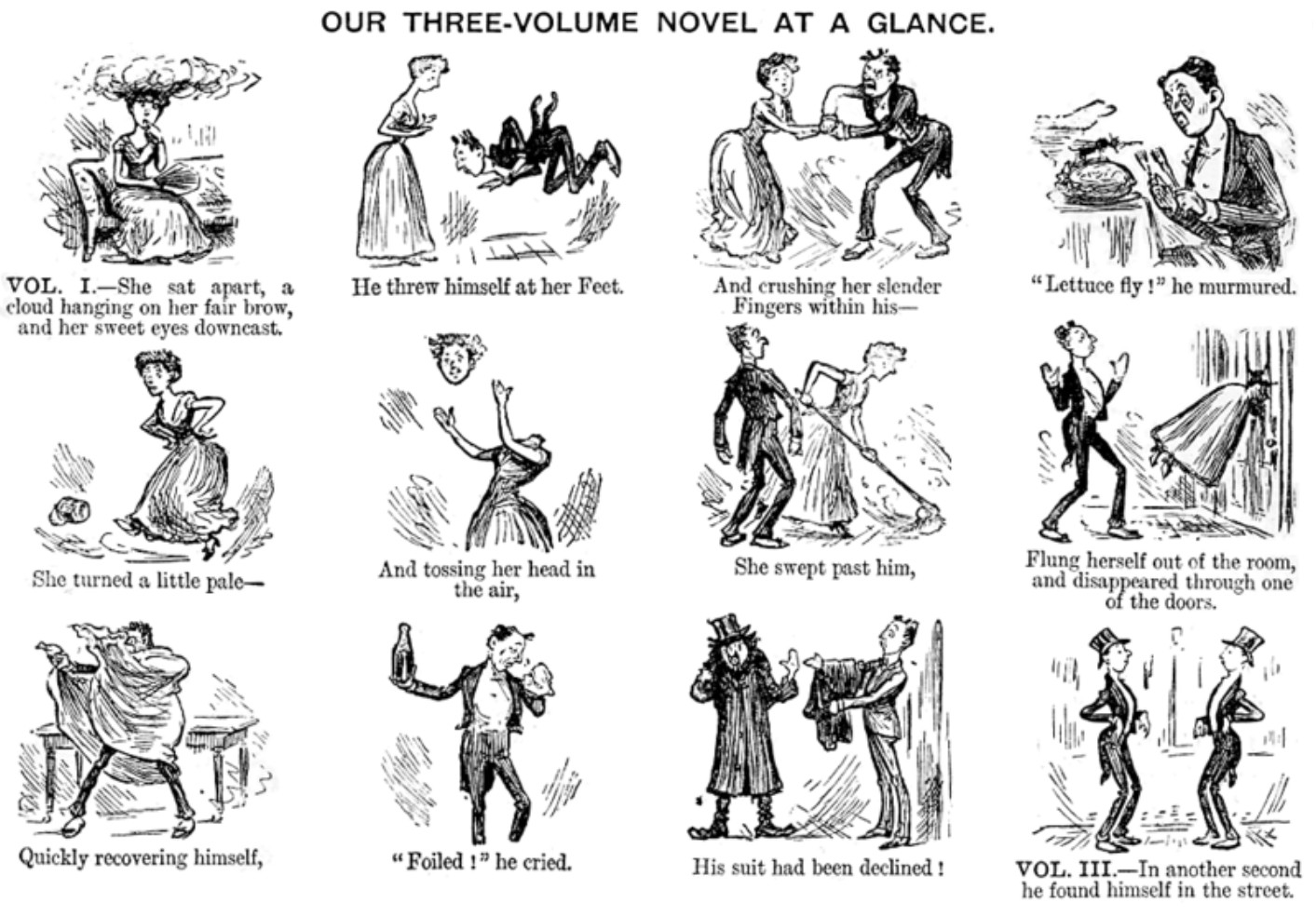
I found this photograph on Wikipedia with the definition of Cliché.  It’s pretty old, and the copy right is outdated.

You can tell, even with how old this cartoon is, that if they were making fun of some clichés this long ago, what would they think now?

I must admit, I am guilty myself of using the last one.  Now that I see it in a picture, I have to giggle.  Sometimes, I think you need to have something drawn to see the “funny” in it… Like tossing your head in the air.

The publisher who redlined the Gold Mine Manuscript marked “in a split Second”, “Looked her in the eye”, “Laid low” and “in all shapes and sizes” as  clichés.   They also said that eyes don’t meet, but gazes can meet.  (Can you picture two people’s eyes actually meeting?  Now that I have that visual, I stop every time I start typing it.)

There are a lot more that are common, that we probably aren’t even aware we are using.  For me, now that I think of it… My characters always drop their eyes.  I guess I can change that to “lowered their gaze” since they aren’t actually dropping their eyeballs out of their heads.

I’ll also mention that they weren’t crazy about colloquial expressions either, as they thought they wouldn’t be understood by everyone, so use those sparingly as well.

Write on!

Lesson Eight from the Manuscript Red-Line: Magically Appearing Items in the Setting

For an intro into where these tips are coming from, please see my post: A Full Manuscript Rejection, or a Gold Mine?

This is really more like an amendment to Lesson Seven, but I figured I’d call it out separately, just to make it more clear.  In Lesson Seven, we discussed how important it is to make sure a character has a reason for doing what they do.

Also watch for “convenient” items popping up out of nowhere.  In a recent writers group meeting we discussed this very topic… making sure that a gun doesn’t suddenly appear in the glove compartment of an eighty year old grandmother from Ohio…  Silly things like that.

It is easy for a writer to place an item somewhere convenient…  but remember to give that item a reason for being there.

Example from my own manuscript:

Meagan has a candle in her room in the end of the novel.  It’s very important.  It’s never mentioned before, but I talk about it like it’s always been there.  I  caught mistake after digesting Lesson Seven.   I just can’t let the candle suddenly appear like that, and act like it’s always been there.

Convenient fix by me:  I needed a new chapter near the beginning of the novel, because I needed a place to SHOW that Meagan realizes that Magellan is supernatural.  (This is to avoid a “telly” section later).  I placed the scene in Meagan’s room, and actually used the candle as the driving force for that scene.  It worked wonderfully, and I killed two problems with one chapter in a neat little
package.  (And only about 550 words)

Like magically appearing characters, suddenly appearing items can be distracting, and make you lose credibility.  Give important items a reason for being where they are, and keep your settings fluid throughout your novel.

Lesson Seven from a Manuscript Red-Line: Where did that character come from?

For an intro into where these tips are coming from, please see my post: A Full Manuscript Rejection, or a Gold Mine?

This is another comment that seems silly when you say it, but when I was thinking over my own manuscript (and one of the comments that a BP made that I blew off) I think I may have one of these mistakes, too.

The publisher red-lined a scene where the phone rings, and there is a conversation, but it is never really clear why the second character called in the first place.  Yes, some important information is exchanged during the conversation, but the reason for the original call is never made clear enough.
The comment from the publisher was that all actions must have a reason from the character that created that action in the first place.

Now, thinking over my own manuscript… There is a point where Magellan and Meagan are in the Aviary when the lights go out.  They are worried about Jerric, who is also in the aviary.  Meagan calls out his name, and Jerric steps out of the bushes and says “I’m right here.”

One of my BP’s said: “that is awfully convenient.”

I think this is pretty much the same thing as the comment above.  There needs to be a reason for him to be there.  Honestly, there is.  He is watching them.  The problem is, I never SAY that, so there is never actually a reason (in the reader’s mind) for him to be able to step out of the trees so easily.

So, where I  “blew off” that comment before, because I knew why he stepped out of the trees, now I am going back to make it more apparent that he was standing there and listening.  I have to let the reader know why it is so easy for him to step out of the trees.

Always make sure there is a reason for your characters to be where they are, and a reason for them doing what they do.  Other wise, as this publisher puts it, it  ends up sounding “contrived” or, as my BP put it “too convenient.”

Lesson Six from the Gold Mine Manuscript Red Line: Watch that Voice!

For an intro into where these tips are coming from, please see my post: A Full Manuscript Rejection, or a Gold Mine?

When you are writing, especially if you are writing YA or middle grade, watch the voice. In the Gold Mine Manuscript, I know I mentioned the voice when I was beta reading, but my BP said her teenager read it and said it was okay, so I figured maybe I was just behind the times.

In this novel, the Main Character is supposed to be 15, but my brain just made him 17 (no matter what the novel was telling me).  Do you know why?  I believe it was the voice.  I mentioned it, but my BP seemed comfortable with it, so we moved on.

I was also having the same struggle in my own novel, and was on an up and down roller coaster with my own young character’s voice, so I know how hard a young boy’s voice can be, so I knew I was no expert.

You know what the publisher marked up over and over again in the gold mine manuscript?  THE VOICE.

They mentioned that teenagers answer in quips and half-completed sentences.  I have to admit, my middle graders do the same thing. No perfect grammar for them.  Simplicity is the key.  “Yeah” instead of “yes” is more realistic than a full sentence.

I’m wondering about my own novel on this one.  My kid is from another planet, and grows up under the tutelage of a King.  I don’t want him saying “yeah”, but I don’t want a publisher calling me on it, either.  Maybe a few of the other characters can slip on their grammar a little.  Hmmmm…

My suggestion:  If you are writing for teens, get several teens to read it and ask them to be honest.  Same goes for Middle Grade.  This publisher actually had a teenager read the manuscript to make sure of the voice, and the teen said it didn’t sound real and they didn’t get the words she was using.  Yikes.

Moral of the blog:

If anyone reads your manuscript and tells you that there are possible problems with the voice, I’d take them seriously… ask a few more people to read it.  Drop it on a web site (I like Nathan Bransford’s site).  Get as many opinions as you can.
In the end, you still might not end up okay.  (To be honest, my five-year old drops bonus S.A.T. words all the time, so if I wrote his voice for-real, this publisher would red-line it—so who knows?)

There are a lot of things I’ve not changed about my manuscript that people have mentioned, but voice is one that I have always paid attention to.  If one person mentions something, I may tweak just a little, but if a few people mention it, I tweak a lot.  There is still a possibility that my MC may age a few years in the opening scene, just because of voice issues.

Don’t fall in love with your characters so much that you cannot recognize that their voice is all-wrong.

Lesson Five from the Gold Mine Manuscript Red Line: Let’s keep it in the past

For an intro into where these tips are coming from, please see my post: A Full Manuscript Rejection, or a Gold Mine?

I suppose this doesn’t work for those of you who are trying to write your novel in the present tense.  If you are, personally I have to ask you to stop.  Yes, okay, it is a style thing, but I just can’t get into it.  I’ve read a few passages in present tense, and I always end up feeling tense (as in irate).  To me, past tense is the way to go.  (Of course, maybe I just haven’t read a good one)  Anyway, for those of us writing in the conventional fashion…

This publisher noted that present tense words are okay in dialog only.  In narration, they should be cut.

Now, in the gold mine manuscript, the present tense word was “almost” used as narration.  It was “sort of” an inner thought.  The POV character looked at a big mess, and was thinking about cleaning it up, and the narration said “he’d have to tackle it today.”  Now, I think the problem is that it was set off as narration, not as a complete inner thought.  If it was in italics, like the POV character was actually saying it in his head, it may have been okay (again, this is my opinion here).   But since this writer’s style is to have most of the character’s inner thoughts as narration instead of italic thought, this publisher found the use of “present tense” words to be a problem.

So, in a nutshell… if the narration says:  He’d have to take care of things today.  This is no good.

However, if the same character says out loud, or as an inner thought: “I’ll have to take care of this today.”  That is fine.

That’s a pretty simple one, but it might be one many overlook if they have their inner thoughts as narration.  This can be overcome simply be making your inner though more concrete, and putting them in italics so it is very clear that this is an inner-thought, and not the narration.

Amendment:  Guess what?   I just found one of these in my own manuscript!  In the MC’s POV, the narration says:  – It isn’t cold, like it is here.— Now, this isn’t past tense, but the “here” sounds weird because it is in the narration.  I need to change this into an italic thought, or change the wording to be slightly more detached.  One or the other.  It is basically the same principle.

Happy editing!

Lesson Four from the Gold Mine Manuscript Red Line: And Then there was a Conjunction, or Was There?

For an intro into where these tips are coming from, please see my post: A Full Manuscript Rejection, or a Gold Mine?

Originally, I was going to skip over this, because I thought it seemed a little obvious.  But then I thought, maybe not.

This publisher simply hated the idea of “and then”.  They said: “And then is not a proper conjunction.  And is a proper conjunction… use for, and, nor, but, or, yet, so which are considered “proper” conjunctions.”

I did a search in my own manuscript, and found 73 instances of “and then”.  Honestly, I was a little surprised to find so many in my story.  The more I thought about it, every instance is like a laundry list “tell sequence”.

Matt did this, and then he did that, and then he did that. (It was not quite so blatant, but you get the idea) If you think about it, it’s kind of funny.  I know when I was beta reading the manuscript for my BP, the “and then’s” did pop out here and there, but I just figured it was writing style.  I didn’t particularly like it, but I let it go.  I didn’t even realize I was doing it myself.  Now that I’m re-reading with these comments in mind, they are popping out and blaring:  No No No!

So, my advice is, do what I did:  Do a search/replace on your manuscript just for starters.  Search for “and then” and replace with “and then” (just make sure you spell it correctly)  It won’t change anything, it will just give you a count of how many times you did it.  If it’s a lot, search again and start editing!

This is an easy fix.   I’m not saying this will bother every publisher, but if it’s a pet peeve of one publisher, it will probably bother another one, or two, or three.  Personally, I’m not willing to take a chance and let them go now that I realize what I’ve done.

Happy editing!

Lesson Three from the Gold Mine Manuscript Red Line: Action Action, where is the Action?

For an intro into where these tips are coming from, please see my post: A Full Manuscript Rejection, or a Gold Mine ?

I’ve heard contradicting opinions on this.  Some people say exposition is important.  Some people say don’t start right out with action because you don’t have a character basis of who to “root for” yet.  Personally, when I’m reading something, I want to be slapped in the face immediately with excitement and fill me in on the boring stuff later.  So, when my BP (Beta Partner) had a story that started with tons of talking and setting, I said, “okay, according to what I’ve read, this is okay,” but, being the good beta partner that I am, I let her “have it” and told her I was bored.  But, all the exposition stayed (with some trimming to six pages).   (I’m not saying she trimmed for me…  I believe she has five beta partners, so I’m sure there were a wealth of comments to revise from.)

 Unfortunately though, the publisher found it to be an unnecessary character study and suggested cutting the first five pages completely.  What was after these five pages, was a brief conversation of a dream that actually had relevance to the story (almost a page long) and then the action started.

The publisher’s commented that the first five pages were not engaging.  What I got out of that, was that they didn’t want to see a few kids hanging out and talking.  They wanted something to HAPPEN.  The story actually does, I must admit, start right where they suggested… The dream is a foreshadowing, and then the action that is the catalyst that changes the MC’s life forever happens right afterwards.

***Always start the story as close to the life changing event as possible***

So, what gets lost in the first five pages?  Well, the set up of the friendship between the two MC’s, which can be played out pretty quickly in the next pages, and (ouch) a lot of setting.  To me, that’s no biggie, but my BP is a big setting person.  She likes her imagery.  Now she needs to work in her sweeping mansion and grounds into the action scenes or between them.  It will be a little work.

Moral of the story:  Setting is important, but not too much up front.  Make sure something happens in the first page or so to drag your reader in.

Also see my post on how I changed (and am still changing) my first page after a contest judge didn’t find my first page exciting enough— and there was hardly any setting there at all!

Go back and make your first few pages ROCK!  If you don’t excite the reader right away, they might put your novel down and buy something else.  **GACK**