Tag Archives: beta reading

My First Face to Face Critique Group

Believe it or not, up until today I had never been part of a face-to-face critique group.

There weren’t any around me, and I didn’t want to travel all the way into the city and pay $30 for parking.

I had thought of starting my own, but hesitated because of the work involved with being a moderator.  Then, luckily enough, a friend of mine started one ½ hour from me.  She was so nervous, and very happy when I signed up… THe old strength in friendly numbers thing.

In retrospect, we discussed a few mistakes, one of which was opening it up to ANYONE who was interested.  She was trying to be nice, but it was frustrating to get there after critiquing ten pages of 4 other authors, and only having two other people show up. (The moderator, myself, and another participant)

It worked out fine, but I wasted valuable time reading and critiquing twenty pages for two people who will never see my comments,  — and if you know me… 20 pages equals about 90 comments. I am very thorough.  Also, I won’t see what they did for me (if they ever even read mine in the first place)

In retrospect, we discussed only opening up the critique sessions to established members of our writing group (which is 300 members strong).  This way, we can be sure the people are already invested, and not just “fly by night”.

What WAS good was that the three of us who came were serious.  We critiqued each other’s work, and since we had an extra hour, chatted further about each piece than we would have been able to under normal circumstances. (If the other two showed up)

I was particularly tickled that they both asked for the rest of my work (Last Winter Red) because they liked it so much they wanted to see what happened.  Everyone needs a little ego-boost now and then 🙂

Did they come up with anything my beta-army didn’t?  Yeah, a few things.  Every set of eyes notices something different.  What was cool was that I could talk to them about it.  The only problem with on-line beta partners is that you have to email back questions, and sometimes that’s hard.  Here, we just chatted it over.

Probably— if I knew who the people were, and I could trust that they would show up.  I believe that the more opinions you get, the better your work will be… and someone may just see one word that is wrong that everyone else read over.

Also, I love getting out and chatting with other writers.  I love helping people develop.  There are so many people out there with great ideas, they just need help formulating them in a marketable way.

I was there once (a novice), and it was not too long ago.  Someone helped me.  Okay, a lot of people helped me.  Gosh, I was bad… but my ideas were good.  Now that I know a little bit about writing, it’s my turn to share the wealth.

That’s not to say that I don’t make the same silly mistakes all the time.  I am nowhere near arrogant enough to say I don’t need my beta-readers.  I am just to the point where I know what they mean when they think something is not right.  I can look at their comments, hit myself in the head, and I know EXACTLY how to fix it.

Other writers taught me how to do that.

Now, I can give that knowledge back to others.

Writing to a Deadline Part 8: “Calling in the Beta Reading Army”

If you’re just hopping into the insanity that is my writing life, check out my previous “Writing to a Deadline” posts or this won’t make sense.

I was happily surprised when I sat down to edit, that I had very few things to change.  Mostly typographical errors and little things like switching sentence structure to make it flow better.

The one scene that I purposely wrote as “tell” took a little time to work out, but it’s finally done.

So, I took a deep breath, and called in a Beta-reading army.  Crossed genres and ages.  These are all people I have a fairly high trust factor with:

Two are currently mercilessly ripping apart my novel and making great comments

One is a college professor who teaches creative writing (She has never read my work)

One is a Romance/ Middle-Grade soon to be publisher author who hasn’t read my work (she’s there for that kissy stuff I’ve never done before)

A memoir writer, who also has not read my work

A High Fantasy writer (my writing buddy for the past year or so—-who’s sick of reading my work) (ONLY KIDDING!)

My first ten pages will also be reviewed by three people in a critique group who I’ve never met before.

It’s kind of like submitting to a publisher, but you know these people will get back to you.

Funny, I was more nervous about this beta-read than I was about my novel.  Probably because I feel deep down, that the story is pretty solid.  After dissecting the Gold Mine Manuscript for seven months, I think I know what NOT TO DO.  The question is… did I write what I THINK I wrote.

I also have that deadline looming over my head.  And I don’t want to wait until the last minute… just in case the publisher decides to close for submissions early.  It’s enough to make you a nervous wreck.  Will I have time to make all the changes they might suggest? (If I agree with the suggestions, of course)

By request: Who’s verses Whose

It never occurred to me to do an article on Who’s verses whose, because I don’t think I’ve ever had a problem with it.  I can see how this could be confusing, however.

I will try to make this as simple as possible.

Who’s” is kind of like “it’s”.   It is a contraction of two words.

Who is going to the store?

Who’s going to the store?

Whose is the possessive form of “Who”.

Who does this book belong to?

Whose book is this?

I believe the problem that may cause confusion is that sneaky little apostrophe.  In most cases apostrophe with an “S” denotes a possessive.  That is not true for “who”, or for “it”.

It’s just another one of those wonderful little rules that make the English language so much fun!

Hope this helps!

What Stupid writing thing did your beta reader come up with this week? “As” easy as it seems?

Apparently, I like the word As.

It’s a little word.  So small, so subtle, BUT SO TROUBLESOME.

Yeah, I admit it, I’m an “as” junkie.  I love combining sentences.  I like the way “as” makes sentences flow together in such a beautiful flowery way.  But, unfortunately, too much of a good thing stands out.

The lovely Miss Ravena went through my manuscript and started highlighting my “as” addiction.  Oh, what a colorful page I received back!

Did I get rid of every one of them?  Of course not.  I just reworded sentences where they were not absolutely necessary.  I tried to make sure there wasn’t more than one “As” in a single paragraph.  In one instance there were three in a paragraph, but I could only drop to two.  Anything else and the pacing would have suffered (in my opinion).

So, yes, I still have the dreaded “as” used as a conjunction in my manuscript.  Tabu?  Maybe a little.  I’ll watch for it, but I’m sure I’ll do it again, and again.

It is, after all, an addiction.
You won’t catch me giving up chocolate too soon, either.

What stupid Writing Error did your Beta Reader come across this week? – Verb Confusion.

I just love verb confusion.  It’s a riot.

Unless someone points it out to me in my own work.

Okay, well it’s funny for me too, as long as I catch it in time.

The lovely Miss Dawn just pointed out to me that I have to be especially careful with my verb confusion, because in a fantasy world, it is entirely possible that furniture might come to life.

This is what I wrote:

Nurses tended to beds holding the badly infected.  Some held the patients withered hands.  Many smiled.  How could they provide comfort?  Weren’t they afraid?

I read this at least ten times on my own.  I knew what I thought I wrote… a beautiful scene of nurses tending to their patients.  But when Dawn read it, she saw nurses tending to the beds, not the people.  She saw beds holding the badly infected people.  (Like the beds were alive)  She also saw smiling beds.

When I read it back, I realized (after I stopped laughing) that she was completely right!

Thank goodness this is a very simple fix.

Nurses tended the badly infected.  Some held their patients withered hands.  Many smiled.  How could they provide comfort?  Weren’t they afraid?

The funny thing is, Dawn is a new reader for me.  She is not a fantasy writer, and she picked this up.  Three other people completely missed this.  That is why you send your manuscript out to multiple people…. To save you the embarrassment later.

Thanks, Dawn!

Stupid things your Beta Readers Find: Letting Your Villain Off The Hook Too Easily.

This is one of those “type things out to clear my head” posts.

I’ve written before that if one person makes a comment, consider it.  If two people make the same comment, seriously consider it.  If several more people make the same comment, revise.

I’m wavering on this one, though.

When I request beta reads, I ask for people to express the emotion they feel in each chapter.  A few people have said that my villain gets off the hook too easily.

Now, are they expressing an emotional response, or do they think that’s an error on my part?  That is what I am trying to figure out.  Even after questioning them, I am still not quite sure.

For one thing, they all would have squawked at my first seven or so drafts, where he completely got away with it.   I’m at least happy with my decision for him to get caught.

I can’t have him die a horrible death though, because then he can’t come back with a vengeance to really screw with Magellan’s head in another book.

I guess the visceral reaction of people is that if someone kills almost a hundred people with no remorse, he should get no less than that in the end.  The problem is that my villain is just too much fun.  Everyone has said that he makes their skin crawl, but they love it.  He is a great character, and I want him to come out and play again.

I think the problem might lie in the fact that you see him get caught, and you see the initial “punishment”, but you don’t get to see the aftermath… but if I do go and show the reader that aftermath, it will get red-lined because that is not intrinsic to the main-plotline for a POV character to be there to see it.

I don’t really have to show you the aftermath… I can show you the emotional response of the aftermath from another character’s POV.  I can intertwine that into the main plotline as the characters move into the final scene.

That’s it!  I got it!  I knew talking to you guys would help. You are all so smart!

Gotta go!  The idea is bursting out of my head, and I need to write it down before it disappears!

What stupid writing thing did your beta find this week? I bet you have a writing crutch, too.

Do you have a writing crutch?  Is there something you do over and over again, but you have no idea that you are doing it because it feels right?

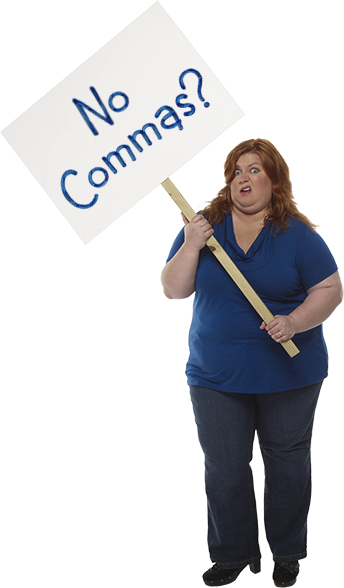
Mine, apparently, is the use of commas.  SEE!  I just did it again!  I naturally place a comma anywhere where I would pause if I were speaking.

Funny, a beta called me on this last year, and I thought he was nuts.  Several other betas have corrected my commas here and there, but didn’t mention my overall addiction.

Recently, a new beta said (paraphrasing) “I’ve read your blog, so I expected you to overuse commas in your novel, but it really slows down the reading.”

I honestly didn’t even realize I was doing this.

Now I am looking for them like a hawk in my novel.

So, what about commas my blog?

I don’t know.  I might let them fly here.  When I type out a post, you should feel like you are talking to me.  If there is a comma there, I am probably taking a cyber-breath.

What do you think?  Do they annoy you?

I find this extremely funny, to be honest. (Tee hee, there is another one… they just fly out of my fingers.)

I’m not editing any of my natural commas out of this post, just for the fun of it.  This is how I speak.

Now, I just need to make sure all my character dialog and narration doesn’t suffer from my comma frenzy as well.

What do you do in your writing that shoots out of your fingers without you even realizing it?  (Gosh, do I want to put a comma in that last sentence, just to break it up a bit!  ARGHHHH!!!)

What stupid writing thing did your beta find this week? Darth Vader Syndrome

My characters breathe.  There.  I said it.  THEY BREATHE.  People breathe, right?  Get over it!

Ugh.  A beta recently said “your characters breathe a lot.”  Hmmmmm.  Do they?  Nifty little count-it trick to the rescue (Click here if you need the trick)

Yikes!  In 50 pages different characters breathed deeply, or took some sort of a breath 23 times!

No No No NO!  She smacks herself in the head.

Now…. breathing.  It’s normal.  Everyone does it, right?

Ergghhhhhh.  I think the deep breathing was a spastic reaction to making sure they don’t sigh too much.  I guess my sighs turned into deep breaths.  Now they all walk around sounding like Darth Vader.

The problem is, this seems normal to me.  If I think hard about something, or I am about to say something important, I feel myself taking in a deep breath.  Some call that a sigh.  Because I do it, my characters do it.  I guess I need to curb that habit.

It’s hard though, isn’t it?  There are just so many descriptive words in the English language that don’t jostle you out of the story because they are too “odd”.  It leaves us stepping, looking, sighing, and taking deep breaths.

Ugh.  No one said this writing gig was easy, my friends.

You just have to stop breathing.

I’m talking about your characters.  Breathe, QUICK!  You’re turning blue!

Whew!  That was a close one.  You guys gotta stop taking me so literally.

Watch for words you use too much.  Trust me, you won’t even see them.  Someone will have to point it out to you and make you feel silly.

Writing to a Deadline Part 2: “I still got Nothing.”

In Part One, I told you about this publisher’s writing prompt.  I told you I decided to pass, even though it was a great opportunity.  It nagged at me, though.  I have written two Epic 400,000 word series.  Why the heck couldn’t I do something with this picture?

I opened the web site back up.  I stared at that picture.  I was brutally aware that I was now two-weeks behind all those happy writers that seemed to be all over this story.  I could do this.  I stared at the picture some more.  I put it on my desktop.  Looked at it all the time.  Thought about it all the time.

Had I lost my touch?

“Just do it,” my son says. “Just write it.  Get it over with and see what happens.”  I ground my teeth as my own words came back to haunt me.  (See my previous post)  Problem was… this was a publisher, not a fourth-grade teacher.  They wouldn’t be happy with a “B”.  This needed to be “A” grade work.

I had no idea where to start, so I used a trick that I’ve used in my novels when I’m not sure how to start a new chapter.  I took the character in the picture—  I knew nothing about her, just what she was wearing and a setting.

I sat down to my keyboard, and had her take a simple step.  The wind whipped up around her.  Her shoes got dirty in the mud.  The air chilled her face… I engaged myself into her setting.  I allowed myself to feel her.

You know what happened?

Within one paragraph, I knew who she was.  I knew where she was going.  I knew how she had to get there.  I knew why she was going.  I knew what she had to do.  Her character snowballed in my mind.

Do  have a story?  Well, no.  Not yet.  I need more characters.  I need to develop those characters.  I need conflict.  I need antagonists.  I need explosions.  I need overlying theme and plot.

But I had a start.  And, to my surprise, I was suddenly interested in that woman in the picture.

Stay tuned.

Lesson Thirty from a Manuscript Red Line: Finale! Summing it all up

Wow.  It has been about 7 months since my beta partner and I sat on the phone pulling our hair out over the comments the publisher made on her manuscript.  I think at this point I have hacked up and drilled everything they had to say as much as possible.  The rest of their comments are just repeats of the same mistakes throughout the work.

Sooooo….. This is the last one.  Thirty posts in all.

So, did this help you?  Did you learn from this?  I totally did.  My novel is much more crisp, clean, and fluid as a result of all this information.  I hope you have benefitted as well.

Now the only problem is…. What do I post about on Monday nights from now on?

**GACK**  I have no idea!

Here are all the lessons in a sparkly package for you.  If you missed one, I’d suggest going back and taking a look.  Heck, maybe read them over again to get a fresh perspective.

I hope that you have all benefitted from these lessons as much as I have.  I’d also like to send out a special “thanks” to the brave author who was nice enough to allow me to slice and dice her red-lined manuscript for all the world to learn from.

Just out of curiosity, which lessons helped you the most?

I truly hope all of you will have the opportunity one day to add the revised version of the Gold Mine Manuscript into your own libraries.  Once it is published, (with the author’s permission) I will let you know so you can all see the value of good clear suggestions, and the results of hard work and editing.

Introduction

Lesson One:  Write without Looking

Lesson Two:  Do we like your main character yet?

Lesson Three:  Action Action, where is the Action?

Lesson Four:  And Then there was a Conjunction, or Was There?

Lesson Five:  Let’s keep it in the past

Lesson Six:  Watch that Voice!

Lesson Seven:  Where did that character come from?

Lesson Eight:  Magically Appearing Items in the Setting

Lesson Nine:  Written Any Good (Bad) Cliché’s lately?

Lesson Ten:  Girls Rule and Boys Drool

Lesson Eleven: Pre-Telling

Lesson Twelve:  How Are Your Characters Feeling Today?

Lesson Thirteen:  Keeping inside the Point Of View, Part 1

Lesson Fourteen:  Keeping inside the Point Of View, Part 2

Lesson Fifteen:  How Many POV’s Can You Have?

Lesson Sixteen:  Cutting down your Point of View Characters

Lesson Seventeen:  Who are we talking to?

Lesson Eighteen: What makes your story Unique?

Lesson Nineteen: Don’t annoy the reader

Lesson Twenty: Don’t make things so easy

Lesson Twenty-One: Common, and Cliché Themes

Lesson Twenty-Two: Does your Protagonist “Grow Enough?”

Lesson Twenty-Three from a Manuscript Red Line:  Kindle Syndrome

Lesson Twenty-Four: Remembering where your characters are

Lesson Twenty-Five: Bullying for Bully’s sake

Lesson Twenty-Six:  Capital Letters

Lesson Twenty Seven: Fluidity in Action-The Art of a Good Fight Scene

Lesson Twenty-Eight: Very Discreet Point of View Switches

Lesson Twenty-Nine:  Watch your Synopsis

Don’t forget to let me know which one you enjoyed the most!